
When athletes visualise their performance before competing, something remarkable happens inside their brains. Neuroscientists using functional MRI have discovered that imagining an action and physically performing it activate nearly identical neural circuits. This is not metaphor or motivational speak — it is measurable, repeatable science.
What Happens in the Brain During Visualisation?
The brain's motor cortex fires in patterned sequences during mental rehearsal, the same sequences that fire during actual movement. A 2004 study published in the journal Neuropsychologia found that pianists who mentally practised a five-finger sequence showed nearly the same cortical expansion as those who physically practised the same piece. Their brains reorganised — without a single key being pressed.
This phenomenon — called functional equivalence — is the neurological foundation of all evidence-based visualisation coaching. When you vividly imagine performing an action, your brain treats it as practice. The neural pathway is strengthened. The skill becomes more accessible.
The Research That Changed Everything
Canadian sports psychologist Judd Biasotto conducted landmark experiments showing that basketball players who visualised free throws for 20 days improved their shooting accuracy by 23 percent — almost identical to the group that physically practised every day. The group that did nothing improved by nothing.
These findings have since been replicated across disciplines — surgical training, musical performance, language acquisition, and executive leadership. The common factor: structured, deliberate mental rehearsal produces measurable neurological adaptation.
Mental Rehearsal vs Physical Practice
Here is a question I hear often in coaching sessions: if mental rehearsal is so powerful, why bother with physical practice at all? The honest answer is that mental rehearsal works best as a complement to physical training, not a replacement. When you visualise, you strengthen the neural pathway. When you physically perform, you test and reinforce it. The two together are more powerful than either alone.
For professionals — executives, coaches, educators, entrepreneurs — this matters enormously. You cannot always rehearse a high-stakes presentation, a difficult conversation, or a critical decision in advance. But you can visualise it. And when you do, your brain lays down the neural architecture for performing it well.
Structured Visualisation: Why Method Matters
Not all visualisation is equally effective. Casual daydreaming about a desired outcome produces minimal neurological benefit. The visualisation that generates real change is structured, sensory-rich, and emotionally engaged.
At Vizlab, every coaching programme begins with nervous system regulation using breathwork — stress hormones like cortisol interfere with the brain's ability to encode new neural patterns. Then we build the visualisation scene with all five senses engaged. Finally, we anchor the emotional state of success — the feeling of confidence and clarity that comes from achieving the goal.
How to Apply This in Your Own Life
You do not need a coach to begin benefiting from structured visualisation. Set aside 10 minutes in a quiet space. Take five slow breaths, extending the exhale to twice the length of the inhale. Bring to mind one specific upcoming challenge — a presentation, a meeting, a difficult conversation. See yourself in the scenario. Hear your own voice delivering your message clearly. Feel the steadiness in your body. Hold this image for five to seven minutes, returning your attention to it whenever your mind wanders.
Do this daily for 14 days. Then assess the difference in how you perform in that situation.
The Vizlab Approach
Every coaching programme at Vizlab begins with this neurological foundation. Understanding why visualisation works — not just that it works — is what separates clients who practise it consistently from those who try it twice and move on. When you understand that you are literally rewiring your brain, the practice becomes non-negotiable.
If you would like to explore what structured visualisation coaching could do for your career, your leadership, or your team's performance, book a free discovery call. The first conversation is always exploratory — no pressure, no commitment.

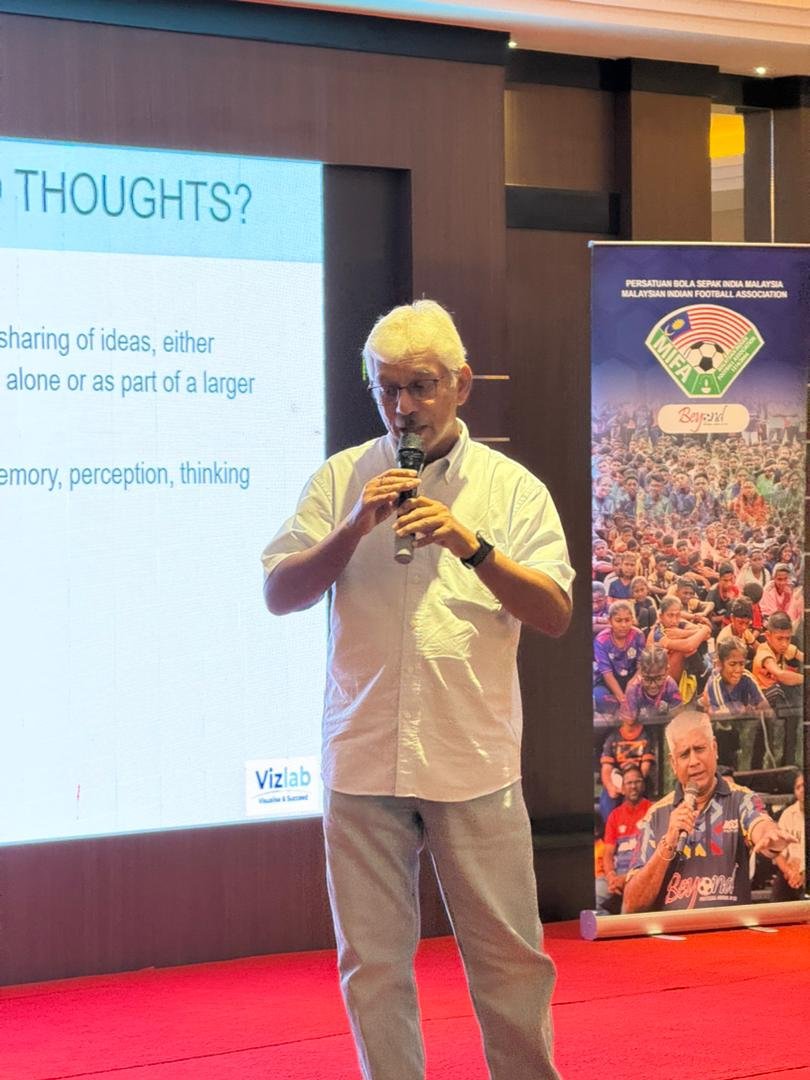
Coach Rajan
Malaysia's evidence-based visualisation coach. Helping professionals, executives, and students achieve peak mental performance since 2020.
About Coach Rajan →